
Harborcoat
My 2025 in Word, Image, and Sound

Another year of endless political horror, 2025 brought us a constant and enraging debasement of everything decent and humane and noble about civic life in this country. The only things I have to contribute here are an itching, burning hatred of the Democratic Party, to which I have belonged my whole adult life, and which has long since collapsed into a cesspool of corruption and uselessness. I find myself thinking often of the late Hunter S. Thompson, whose virulent contempt for middle-of-the-road liberals like Hubert S. Humphrey, contemporary simulacra of whom are everywhere, was so bracing and funny. We could sure use a voice like his now. We will not find anything close to an equivalent at the New York Times, which in the face of world-historical crises has failed as catastrophically as any media institution in American history.
I have unhappy and conflicted instincts when it comes to political art, but one unqualified and affirming triumph was Corrections, a small but gut-wrenching show by a young artist named Jesse Krimes, at the Met. Krimes, who spent four years in prison on drug charges, created ghostly murals and objects out of such commonplace materials as soap, newspaper, toothpaste, pebbles, and string. In description, this sounds like it could be facile and didactic, but the artworks themselves are sophisticated dances of process, material, labor, and conception.
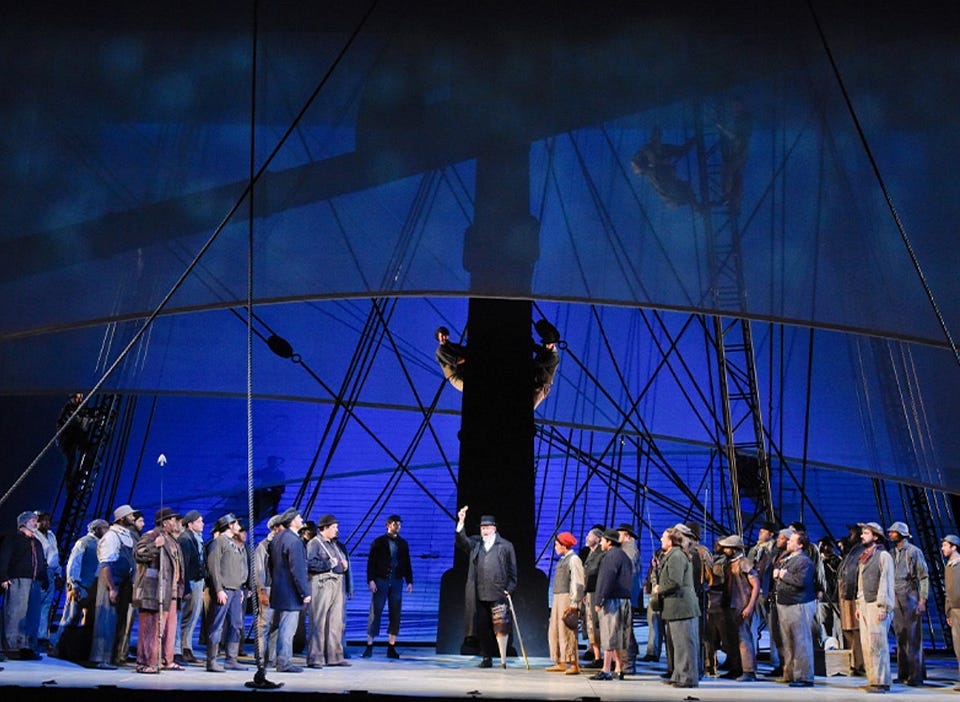
Making an opera out of Herman Melville’s novel Moby-Dick seems like such an improbable exercise that it at first registers as a setup to a punch line. Nonetheless, Jake Heggie and Gene Scheer’s Moby-Dick made its Metropolitan Opera debut in May, and it was both an impressive feat of music and staging and a slightly ominous harbinger, at once. The adaptation, against odds, works very well — the novel is skillfully compressed into a two-hour narrative that remains tense and engaging, and the ensemble singing in particular is masterful and moving. What bothers me is the performance as an example of the institution’s continued movement towards the programming of Broadway-ified opera-light. The music of Moby-Dick is expressive and evocative while being fundamentally unadventurous (The FT called it “a consolidation of the controversial neotonal movement that has taken opera away from modernism and back to something more traditional” and that’s their line and they are sticking to it.) All this is strategically smart vis-a-vis demographic trends, the future of the medium blah blah, but I find it uninteresting and depressing. The actual whale is a bit of a let-down.
I don’t read much fiction, but I did thoroughly enjoy Cora Lewis’s piercing Information Age. The book is the debut offering of a new press called Joyland Editions, a nimble and cunning outfit whose advent reinforces my conviction that the most interesting publishing happening today is being done by small and independent presses. Which makes a clumsy segue to Vanessa Chang’s The Body Digital: A History of Humans and Machines from Cuckoo Clocks to ChatGPT, which is my only Melville House title of the year, and one in which I take an inordinate pride. Dr. Chang and I worked on this book for nearly two years, an editorial process that was both challenging and enjoyable, and which yielded a brilliant and very au courant piece of cultural criticism.
At least three other outstanding non-Melville House books of literary or cultural criticism were published this year: Authority: Essays, by Andrea Long Chu; Low: Notes on Art and Trash, by Jaydra Johnson; and Medium Hot: Images in the Age of Heat, by Hito Steyerl. Chu and Steyerl are already celebrated and influential critics, of course; Johnson’s brilliant, idiosyncratic first book gives every indication of a promising career. Veering perhaps unwisely out of my lane, I add to the list Alice Bolin’s Culture Creep: Notes on the Pop Apocalypse, which succeeds on its own terms as an insightful reading of millennial iconography and its discontents. Finally, Nathan Kernan’s biography of the New York School poet James Schuyler is an exemplar of the genre: evocative, incisive, and compassionate, containing the kind of analysis that elevates its subject’s work.
That’s it. When I started this yearly-roundup business, way back in that innocent year 2018, I was still a professional bookseller, and it will always be my contention that a bookseller working the floor at an urban indie has a better command, a keener sense, of contemporary literature than anyone. In the long years since my ambit has narrowed. Anyway, anyway, anyway … Majuscule, the literary journal my classmate Dave Kelsey and I founded in 2019, continues to purr along, with another of our essays anointed as “notable” by the editors of the Best American Essays series. My chess winning percentage for 2025 was .498. Tom Stoppard’s play Travesties, from 1974, is perfect. I wrote and recorded four songs. Tarik Skubal had the greatest consecutive seasons any Tiger pitcher has ever had. I started writing a poem cycle whose ultimate merit remains uncertain, but the composition of which has been a lonely but pleasurable nocturnal ritual. The making of this set of three print series was extremely satisfying. Why lovest thou so this brittle worldë’s joy?