
Year's Deep Midnight
Reading Log | Winter 2025-26

“An American Tradition,” in Symbolism and American Literature, by Charles Feidelson Jr. First published in 1952, this essay includes a long section on “the Puritan mind” that, in counterpoint with Perry Miller, I found informative and useful. Feidelson’s essential formulation is that the literary legacy of the Puritans was “a special and extreme case of the modern literary situation: a conflict between the symbolic mode of perception … and world of sheer abstractions certified as ‘real.’” OK! There is a droll meta-narrative here, because I plucked this yellowed paperback off the bookshelves of my 87-year-old father, who bought it while a graduate student at Indiana University in 1962. This means that my critical thinking, such as it is, can be accurately characterized as being approximately three-quarters of a century out of date, which sounds … about right. For me.
Season of the Rat, by Elizabeth Hall. An edgy, funny novella from a queer Californian writer about a woman who becomes obsessed with the rats that populate her run-down tenement and LA neighborhood. This sounds gross and possibly heavy-handed, but it has a fizzy, transgressive energy that is infectious. This feels to me, in some indefinable way, like a book that could only have been written in Southern California, with its blend of innocence and menace, its forced proximities of kitsch and nature.
Replace Me, by Amber Husain. This remarkable book is nearly perfect in its way and represents to me the belle idéal of a certain kind of nonfiction: erudite, discursive, philosophical, one that uses examples from literature and art to illustrate abstract ideas in flux. Like all great nonfiction Replace Me is difficult to summarize. A Marxist, Husain takes as her theme the idea that replacement, as in the substitution of cheap labor for professional labor, or AI slop for human writing, is the central neoliberal idea, but that it is not “natural” and can be inverted in the service of the polis. That sentence sounds like it is describing something horribly boring, but Husain’s prose is so clear, and her quotation of writers from Aristotle to Amia Srinivisan so dextrous, that subtle ideas about power and community are illuminated with ease.
Nymph, by Stephanie LaCava. This is the third novel by a writer who has, in my estimation, an utterly unique voice, one that exemplifies a certain kind of contemporary postmodernism with effortless ease. LaCava’s protagonist is Bathory, the daughter of an eccentric Californian couple who grows up to become a sinister agent in a world of unspecified crime. What gives the book its chilly edge, at once erotic and impersonal, is its curiously elliptical narrative style, its absolute lack of affect— a story deliberately empty of friendship, love, speech, warmth, community, and all the other warm and humble species of intercourse that compose a normative middle-class life. “In biblical magic, you don’t pray for the actual act, you wish for the courage and wherewithal to make it true,” Bathory muses, “to conjure the kill.”
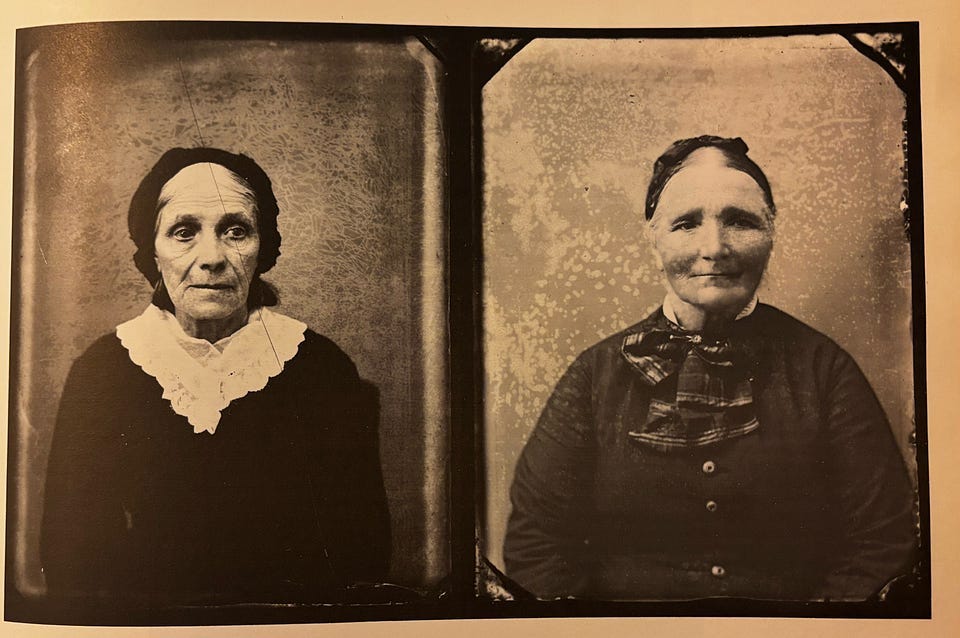
Wisconsin Death Trip, by Michael Lesy. I have never encountered anything like this book. It is an astonishing masterpiece, a central text in American cultural history, and a book of uncanny terror, darkness, and power. In 1973 the historian Michael Lesy came across an immense trove of negatives for photographs taken by a man named Charles van Schaick in rural Black River Falls, Wisconsin, between 1890 and 1910. Lesy culled some 140 of the photographs and arranged them into this book, interspersing them with brief accounts from a local newspaper of incidents of murder, suicide, arson, insanity, and disease.
Looking through this book is an eerie and disturbing experience. As you turn the pages, staring into the somber, unsmiling faces of long-dead men and women who lived impossibly hard lives, reading a relentless catalogue of gothic horrors, an occult, otherworldly sense of the darkness of history begins to seep into you. The effect is incantatory: the summoning of a lost world, a look into the eyes of madness, a vision of a haunted prairie frontier that feels, somehow, like a secret history of the American experiment.
“The Pervasiveness of Identity: The Defeat of the Workers’ Movement and Contemporary Class Struggle,” by Bruno Monfort. An elegant if highly abstract parsing of the perennial and vexing dynamic of tension or concordance between class consciousness and identity. Monfort’s two main points are both obvious, somehow, and misunderstood: first, that the dissolution of waged labor as the primary form of economic experience has radically altered the intricate compound balance of power in the history of ideology; second, that expressions of identity are not automatically inclusive and liberatory, some being outright reactionary or repressive. Monfort defines “class” as “the overarching social relation structuring the way in which identity categories are lived, experienced, and performed,” which is useful when conceptualizing dynamic socialism but maybe not quite so immediately useful when, say, being tear-gassed by agents of an occupying paramilitary force.
Agnes: Poems, by Nina Reljič. This pamphlet-sized offering from a young American poet of Yugoslavian provenance has a sneaky wit and just a whiff of melancholy peeking out from behind standard-issue contemporary free verse. Reljič experiments formally with different formats and line lengths, and there are inventive turns of phrase scattered throughout. “I am partial to words with a little blood still coursing through them,” she writes; the evidence is right there in these lines.
Lover Girl, by Nicole Sellew. Certain women, the writer Nawali Serpell once wrote, “want only to be wanted or to be abjected,” a generalization that feels necessary in unlocking this sly, anomic novel. The titular protagonist is an impecunious soi disant writer housesitting during the offseason on the Hamptons, where she is accompanied intermittently by two rakishly dishevelled rich boys who take turns in her bed. The capturing of the consciousness of this curiously passive woman, of recording the rhythms of her endless interior monologue — by turns self-pitying, funny, narcissistic, and perceptive — is authentically skillful. The narrator has no more moral center than a cat, but she manages to make even a statement like “it’s impossible to make people understand what you’re thinking when all anyone ever wants to do is fuck you” sound like an actual problem.
Strange Biology, by Charlotte Strange. An explosion of hybrid science writing, personal account, and philosophical meditation, this zine-sized essay demolishes not just the borders between literary genres but the borders between inside and out, body and blood, food and intestine, microbiotic and macro-universe. This wild ride is courtesy of the remarkable Brooklyn publisher / store Wendy’s Subway, which has provided innovative cultural programming and events since 2013.